In May 2001, I started Diva Works with a $5000 loan to myself to purchase an Apply Cube and a stack of colour-coordinated stationery.
On September 11, 2001, 2 planes slammed into the Twin Towers in New York, and another was downed in a quiet field in Pennsylvania. There were predictions of World War 3, and of plane travel being severely curtailed as the public became fearful of flying. Fuq, I thought what a monumentally bad time to start a business.
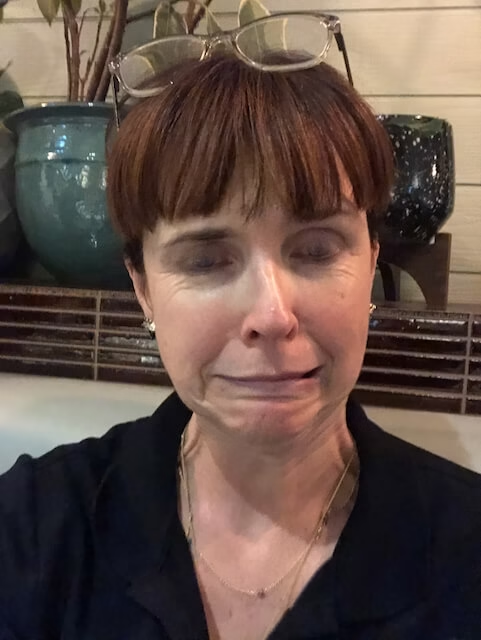
Me, I’ve never been so happy. Running a business is a piece of cake.
In 2008 and 2009, the World economy was annihilated through the US housing bubble bursting and greedy and morally bankrupt bankers and financiers packaging up dodgy loans and engaging in insane levels of borrowing. The GFC was predicted to bring Depression-era-like conditions across the world, and while there were undoubted suffering and austerity, the world largely stumbled on as did many of the architects of the disaster*. Fuq, I thought. What a monumentally bad time to have a small business.
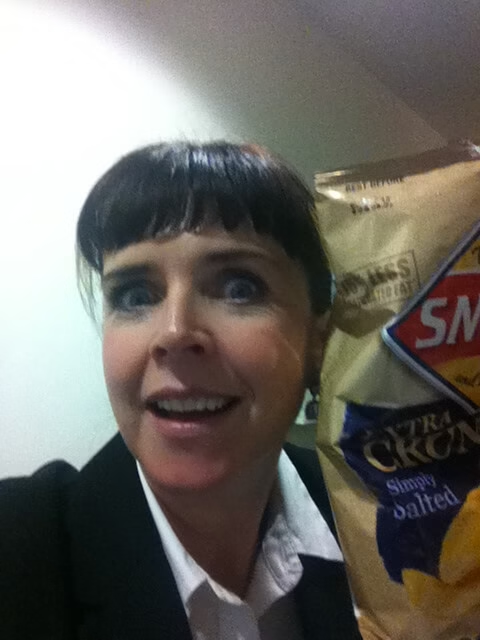
Me, with my 2009 Emotional Support Chips.
In 2020, the COVID-19 pandemic kept us away from each other to slow the demands on the Health System. Businesses were put on life support, and we worried endlessly for our elderly, immunocompromised, and young folk who were particularly susceptible to the worst of the virus. Many businesses could not pivot and folded. Others faced years of stagnant revenue and no clear path out. Fuq, I thought. What a monumentally bad time to have a small business.
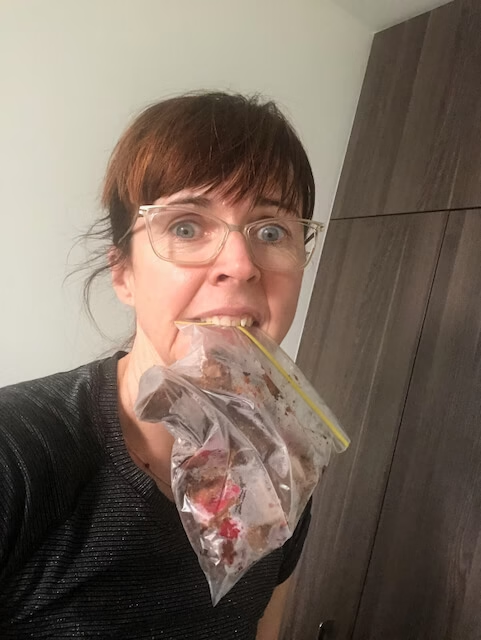
Me, with my 2020 Emotional Support Home-Made Frozen Brownies.
Roaring out of Covid in 2022 and 2023, demand in the economy pushed inflation to white-hot levels. In the construction field, the imperfect storm of limited skilled labour, choked supply chains meant that price rises were coming through almost weekly. Projects still had to be delivered from costs committed to 6 months prior, and I grimly watched as many of the big names in property development and housing went to the wall. Fuq, I thought. What a monumentally bad time to have any type of business.
In 2026, we have an idiot in charge of the World’s Largest Economy and a god-botherer in charge of the World’s Biggest fighting force. What could possibly go wrong when these two window-lickers team up to….look, no one can get a straight answer here, go tussle with Iran. We are already facing massive fuel hikes that will flow through all supply chains, and a daily roulette on whether the Strait of Hormuz is open? Closed? Partially open? Or working as a Toll Booth? There are predictions of World War 3, people embracing Survivalist practices, and Cadbury Dairy Milk Chocolate is $8 a block. Fuq, I think. I yearn for the days of “precedented”. These unprecedented times have got me tired, boss.

Here’s to you, Inflation!
In this short 25-year history of my small business, you can get a sense of what any business owner, solo, small or large, has had to wade through while keeping the vibes high and rubbing the lucky rabbit’s foot. This turn of events just means another opportunity to flex the problem-solving muscle all business owners possess. Here are some ways we’re helping our sales office clients control what they can control:
1. Bring through job sign-offs now so you bank future cost increases
This has been a very welcome initiative by our clients. We are partnering with our suppliers to bring forward quotes for future sales offices, so not only do our customers lock in current costs, but they are shielding themselves against the inflation we will see in the coming months. On another series of projects, we’ve negotiated with our suppliers to store-fit-out items made now for up to 12 months at no additional storage cost, as we know the anticipated timing for us to be on site to install will move out.
We’re very fortunate to have such great supplier relationships, which benefit our clients and give them some surety in these unhinged times.
2. Review your marketing plan, don’t blow it up
Even in my small business, my January marketing plan has been tweaked since Operation “Epic Fury”/”Lion’s Roar”/”Ketamine-Fuelled Freak-Out” happened in late February. The foundations are still in place, but I’m prioritising in-person meetings or getting on the blower to have a conversation rather than 25 social media posts a day.
Perhaps a quick review would benefit you, too. Where do you need to prioritise your spend, and where can you maximise RIO? Could you get the sales office done with a min-refresh? One of our long-term clients is using this time to do a mini-glow-up after we last touched their sales office in 2020. They now have an expanded product offer to include retail and commercial leasing, and rather than investing in a separate leasing suite, they are folding this function into their current space. This will save considerable funds whilst achieving a refreshed space to welcome customers and tenants.
3. People are still buying. How can you reach them?
Many, many people are white-knuckling their way through this period of inflation, but there are whole sections of the economy that are doing just fine, thanks. You only have to marvel at the lines of people snaking around high-end stores like Gucci and Dior or see the throngs of people moving through international airports or cruise terminals to conclude that there is still money washing through the economy.
From what I am seeing in the market, there are several groups that are largely immune to inflation and uncertainty:
- Buyers who are confident in their purchasing power, whether based on their savings or the price they expect for their current property, allowing them to upsize. They have stress-tested their borrowings and have factored in several interest rate increases
- People who have no or a small mortgage, and may be looking at this uncertainty to invest in property
- The Boomers who are looking to shed the large family home in need of renovations and chuck it to buy a brand new, smaller place that better suits their lifestyle
- Multi-generational families looking to share a larger home
If your market has been largely focused on First Home Buyers, it may be time to broaden your ideal customer profile to reach segments of the homebuyer market that are more resilient to the prevailing economic headwinds.
4. Talk to people. Groundbreaking, I know
The property development industry is very relational, which is one of the reasons I love it. If you listen to the most sensational news and social media now, you will swear that Australia is facing an economic wipe-out. No doubt, storm clouds are brewing. However, by having conversations with fellow business owners, our clients, and suppliers, we have found that they have proven super helpful in getting a sense of what is really happening on the ground, and we can workshop possible scenarios and solutions in real time.
Some clients are reporting that their customers are delaying purchase decisions. I know it’s tempting to pause a conversation like this, lest you feel like you’re being pushy, but curiosity can reward you here. Asking “What would help you decide now? What can we do to help lessen the uncertainty?” will provide you and the sales and marketing team with very useful intel. It might lead to a new offer, a customer bonus, a buyer event, an information series or uncover gaps in the sales process. At the very least, it’s demonstrating to your customer that you want to continue the conversation and you’re ready when they are ready to buy.
5. Don’t despair. This is a “normal” turn of the wheel
Some of the greatest business lessons I had were doing the Motor Show circuit back in the early aughts for Mercedes-Benz. When you had to slam 80 tonnes of gear into some sort of premium trade show display on 6 trucks with a crew of 30 men in 7 days across 1000 square meters, it keeps you…sharp and permanently living on your last nerve.
Early in my stint as project manager, I was leaning against a stack of chipboard floor, talking with Tenzing Norgay**. We were on smoko and watching the Ford stand build implode. Ford had commissioned a Chinese firm to build its Sydney Motor Show stand, and it was unravelling as the Thursday Press Launch loomed closer. The 3 turntables that would proudly display concept cars were actually rotating off the stand and taking the tiled floor with them. The pylon signs were delaminating as they acclimatised after the trip across the equator in a humid container, and the information counters were either missing or not in Ford brand colours. Chaos reigned supreme.
Grateful to see that my Mercedes-Benz stand was not suffering the same drama I said as much. Tenzing Norgay (Kevin) nodded and said simply, “The Wheel Turns”, and went back to munching on his sammich. It was a sobering reminder. I still think of it to this day. It’s a wet-blanket fun killer as it stops showboating, but it also dulls the sharpness of disappointments and despair. This is relevant no more than ever. Nothing is forever.
And the wheels are forever turning.
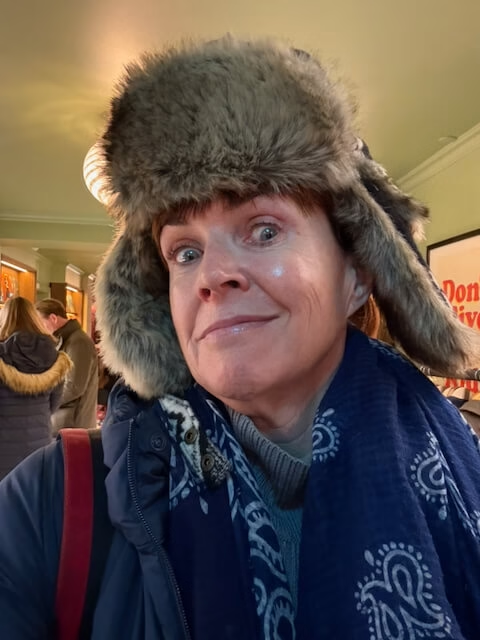
When times get weird, the weird go Pro.
-
Want to talk further about how your sales office can deliver an unmatched customer experience and drive sales in these uncertain times? Book time with me here.
*To this day, one and only one person (certainly no one from the pool of Wall Street CEO’s and executives that were complicit in setting up the conditions that caused GFC crisis) has ever been convicted and sent to prison in the USA for the GFC crisis. If that doesn’t make you mad, it should. These vipers caused the loss of your superannuation returns and flat wages growth for many, many years.
** Tenzing Norgay was the valiant and talented sherpa that climbed Mount Everest with Sir Edmund Hillary. Kevin Stayner, builder and best human, was my Tenzing Norgay on my Motor Show Campaign.
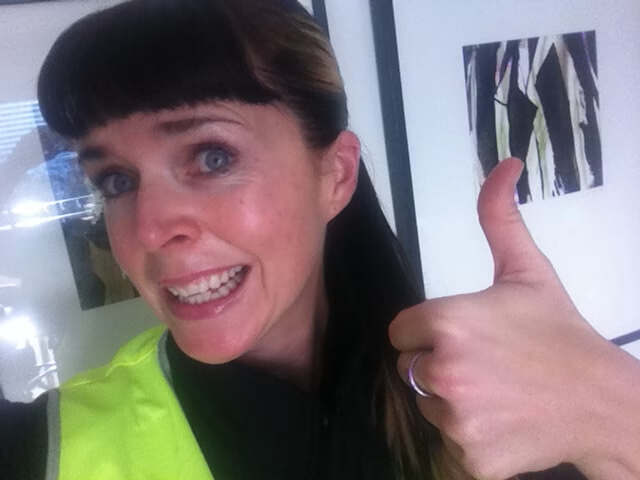
Me. Really happy that the wheel keeps on turning.